

Peak-Hour Bottlenecks
Only one call at a time — everyone else waits.
Enterprise Voice AI · Healthcare
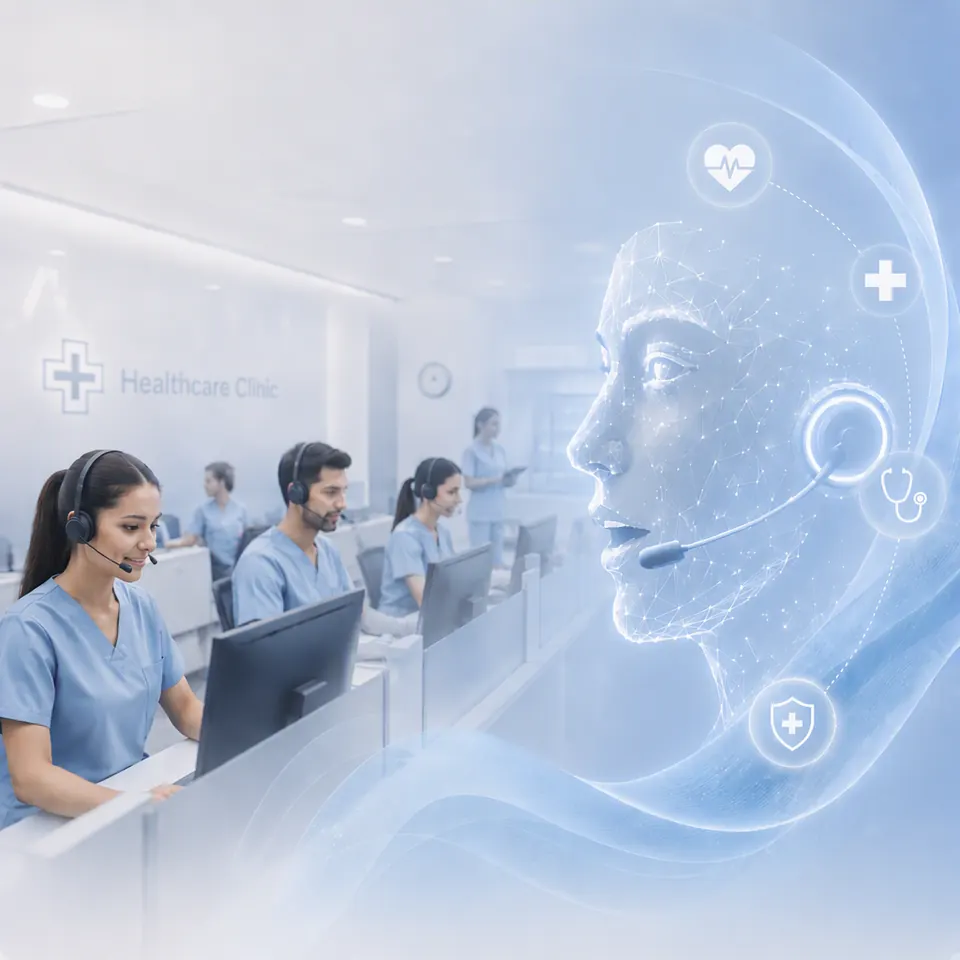
No hold music. No missed calls. No lost patients. Kalimera.ai is healthcare voice AI that answers every patient call instantly, books appointments 24/7, and hands sensitive cases to your staff — sounding human the whole way.
Hear it live
Call from your own phone and ask what your patients ask — “Can I move my scan to Thursday?”, “Do I need to fast before my blood test?” — and hear exactly how we'd handle it. Placeholder numbers shown — swap in your live lines.
The cost of hold music
Healthcare call centers are bleeding patients before care ever begins.
of dental & medical practice calls go unanswered
38% of dental & medical practice calls go unansweredof patients wait more than 2 minutes to be answered
42% of patients wait more than 2 minutes to be answereddidn't get through on their last call attempt
20% didn't get through on their last call attemptUS: Peerlogic analysis, 4,280 dental calls. UK (NHS England): Cloud Based Telephony Data, Oct 2025 and DHSC patient contact survey.
Show Me My ROIWhy this keeps happening
Hiring more staff won't fix this — staffing up for peak hours alone gets expensive fast. Your front desk was built for a quieter era, and your patients feel the impact.
Only one call at a time — everyone else waits.
No one's at the desk when patients call after hours.
Calls, walk-ins, paperwork — phone coverage is first to slip.
Revenue impact
Patient access is the front door of healthcare revenue. The entire patient workflow depends on whether they can reach you first.
The shift
The old way

The Kalimera way
Proven healthcare impact
A real case study, not a demo — see how Kalimera.ai performs in practice. Launched at a single Dimokritos Healthcare Group diagnostic center, it's now live in production across its full network of 15+ laboratories in Northern & Central Greece.
 Dimokritos Healthcare Group
Front-desk teams couldn't keep pace with call volume, risking lost bookings and revenue.
A 98-day case study integrated with scheduling, handling overflow calls end-to-end.
Kalimera.ai's Voice AI answered overflow calls, booked appointments, and transferred complex cases to staff.
See your own numbers
Every missed call has a price tag. Enter your clinic's real numbers below and see exactly what it's costing you — in under a minute.
Your digital front desk
Tell every patient exactly what to expect before their exam — fasting rules, how long it takes, what to bring — so no one shows up unprepared or the visit gets delayed.
Books, reschedules and cancels appointments 24/7, writing directly into your clinic's backend system in real time — with automated reminders and alerts that cut no-shows.
Tells every patient exactly what to expect before their exam — fasting rules, how long it takes, what to bring — so no one shows up unprepared or the visit gets delayed.
Sends confirmations, reminders and results links straight to WhatsApp or email, not just over the phone — so instructions are there in writing whenever patients need them.
A caring check-in before problems happen — no-show reminders, overdue check-up nudges, post-visit follow-ups — and a warm offer to book the next appointment right there on the call.
Why enterprises choose Kalimera.ai
Freedom to swap PBX systems, AI models, or cloud backends without rebuilding your voice workflows.
A/B test voice scripts, prompts and accents live on active telephone traffic, with advanced performance reporting.
Out-of-the-box compatibility with any OpenAPI-enabled system, EHR, CRM or hospital ticketing platform.
Reliably recognizes long alphanumeric strings — SSNs, national ID/insurance numbers, phone numbers, policy IDs — even spoken quickly or digit by digit.
Full audio and searchable transcripts for every interaction, kept for compliance review and quality audits.
Granular analytics and sentiment scoring on every single call — not a sample, the whole conversation history.
Extend the same QA scoring to calls your human staff handle, for one consistent quality standard across the whole team.
Optional add-onBuilt for regulated healthcare
Every AI decision needs to be traceable, not just trusted. Kalimera.ai runs on LangGraph inside isolated, single-tenant environments — fully inspectable, tested before it ever reaches a real patient.
 HIPAACompliant
 GDPRCompliant
 EU AI ActHigh-Risk Ready
 DORAReady
Audit-ready data handling in isolated, single-tenant environments — governed under the same ISO 42001 management system as our certifications above.
Every call runs through a named, auditable decision graph. Compliance can open any call and see the exact reasoning path — not just the transcript.
Every change is automatically re-run against real call scenarios before going live — so behavior never changes without your team seeing the results first.
Backed by the same ISO 42001 system and audit controls as our certifications above.
Getting started
No disruption to existing operations.
Trusted across healthcare & life sciences
The integration of Kalimera.ai’s AI Voice Agent provided an immediate solution to managing our laboratories' incoming calls, ensuring that no call goes unanswered, even during peak hours. Thanks to this technology, patients enjoy immediate 24/7 service, with the ability to contact us at any time, even outside our operating hours.Rodoula Karampatsa, Director, Corporate Communications & Marketing — Dimokritos Healthcare Group

kalimera.ai’s AI Voice Agent elevates our patient experience with instant, personalized care, faithfully capturing the patient-centric ethos and high standards of A-ProlipsisAndreas Ch. Koutsodontis, CEO — Alpha Prolipsis
FAQ
Handing patient calls to AI is a serious decision. Here's what clinic, hospital, and lab teams want to know before they make it.
Kalimera.ai is a voice AI built for healthcare call handling. Most clinics start it on overflow — the calls that come in when every line is already busy — so no patient waits on hold while your team finishes with the person in front of them. It holds a natural conversation instead of reading from a script, and handles routine requests like booking, rescheduling, and general questions without a person on the other end. If a call turns complicated or emotional, it hands off to a staff member with the full conversation attached, so the patient doesn't have to start over.
Clinics, hospitals, and diagnostic labs use it as a permanent front-desk layer that never goes to voicemail, never gets overwhelmed during a call spike, and doesn't require hiring more reception staff as call volume grows.
When a patient calls, Kalimera.ai holds the conversation, works out what they need, and books, reschedules, or cancels the appointment directly in the clinic's own calendar or patient information system — the same one your staff already use. It connects through the same secure channels those systems already run on, with ready-made connectors for the most common healthcare platforms, including HIS and PIS systems, so there's nothing new to build or expose on your side.
After the call, it sends a confirmation and follow-up reminder through whichever channel the clinic already uses to reach patients — email, SMS, Viber, or WhatsApp. That's usually where clinics see their no-show rate drop, since reminders that go out automatically don't depend on someone remembering to send them.
Yes. Kalimera.ai answers every patient call 24 hours a day, 365 days a year, with a response time under 3 seconds — a call placed on a Sunday evening gets the same immediate, professional response as one placed at 10am on a Wednesday. Most clinics can only staff their phone lines during business hours, so calls outside that window are routed to voicemail, and a significant share of those patients never call back. Kalimera.ai closes that coverage gap entirely, letting clinics capture appointment requests around the clock that would otherwise be lost.
That relationship doesn't go away. Kalimera.ai isn't there to replace the person your patients already trust — it's there to make sure the same professional experience holds up no matter what's happening behind the desk. If she's out sick, on holiday, or moves to a new role, every call still gets the same outcome instead of depending on who happens to be answering that day. Calls keep getting handled the same way, appointments keep getting booked, and nothing falls through the cracks while you find or train someone new.
More than that, it's a chance to upgrade what she actually spends her time on. A good part of her day probably goes to routine questions — is a test result ready, can an appointment be moved, what time does the clinic open. Kalimera.ai takes that volume off her plate, so she can focus on the calls where a person genuinely adds value: talking a patient through a treatment plan, following up on a missed visit, or walking them through a service that fits what they actually need.
A standard phone system or outsourced answering service is limited by staffing: someone has to be available to answer, so coverage drops outside office hours and callers get put on hold when things get busy. Under that kind of setup, Kalimera's own data shows roughly 38% of clinic calls go unanswered — more than one in three patients who call get no response at all.
Kalimera.ai doesn't work shifts, and it doesn't work like a phone tree either — there's no "press 1 for reception, press 2 for billing" menu to navigate, because it isn't keyword-based. It understands what the patient actually needs from a normal conversation, using emotional intelligence to pick up on tone and intent the way a person would, and routes the call itself. An answering service can take a message; Kalimera.ai finishes the task and only brings in a person when the situation actually calls for one.
Kalimera.ai connects to the phone system and scheduling software a clinic is already using, so there's no hardware to install and nothing for patients to notice changing. Most clinics go live within 3 to 5 weeks, though the exact timeline depends heavily on how long integration with the clinic's own systems takes — that stage needs close, hands-on cooperation with their technical support team so everything runs automatically end-to-end.
Once integration is in place and we've confirmed how the clinic wants the conversation flow to work, the build goes through QA testing on our side, then gets handed over to the clinic for user acceptance testing — and only once they've signed off does it go live. This is usually enough time to test the impact on a single site or line before deciding whether to roll it out further.
No. Kalimera.ai is PBX agnostic, so it's added as an extension on the phone lines your clinic already has — there's no new number to give out, no hardware to install, and no infrastructure to replace. Patients keep calling the exact number they always have; on the back end, those calls are simply routed to Kalimera.ai instead of ringing out or going to voicemail.
The clearest evidence is a 98-day deployment with Dimokritos Diagnostic Laboratories in Greece. Over that period, Kalimera.ai handled 4,568 overflow calls the clinic hadn't been able to answer and turned 2,078 of them into booked appointments — a 45.5% conversion rate. 92% of those calls were resolved without any staff involvement. The clinic reached full ROI in 2.5 months and measured patient satisfaction at 98%, which tends to surprise people who assume an AI call feels impersonal.
Every answer comes from a knowledge base that's specific to your clinic and kept continuously up to date — the moment a protocol, price, or availability changes, that update is live on every call, immediately. That's different from training a person: bringing a new team member up to speed takes time, and people absorb procedures at different speeds, so answer quality can vary from one staff member to the next, or from one day to the next for the same person.
Kalimera.ai doesn't have that variability. Once information is in the knowledge base, it's applied instantly and consistently — on the first call of the day and the last — and a patient is never put on hold while someone checks with a colleague for the answer.
Healthcare data has to be handled correctly, and that's built into the platform rather than added on afterward. Kalimera.ai holds ISO 27001 (information security) and ISO 42001 (AI management) certification, is GDPR compliant, and is built high-risk ready for the EU AI Act — the category healthcare AI systems fall under. It also carries DORA readiness. Each clinic gets its own isolated environment, so data is never pooled with another customer's, and every call is logged so a compliance team can review exactly what happened on any given call.
Kalimera.ai handles 65+ languages, regional accents, and dialects — for example, it distinguishes European Spanish from Latin American Spanish, and also speaks Catalan — so a multilingual patient base doesn't need a multilingual reception team or a translation line. The AI holds the same quality of conversation regardless of which language, accent, or dialect the patient calls in.
Yes. The voice isn't fixed — it's a choice you make during setup. You decide whether it sounds male or female, younger or older, and how quickly or slowly it speaks, so the call matches how your patients are used to being spoken to. Background tone can be adjusted as well. Kalimera.ai is configured to your clinic's preferences rather than delivered as a single, one-size-fits-all voice.
It connects to any system that exposes an OpenAPI — CRM, ERP, ticketing, scheduling, whatever a clinic is already running — and it isn't tied to one PBX provider, one AI model, or one cloud platform. That matters for healthcare groups running several locations on different back-office systems, since the same AI can be deployed across all of them without standardizing every clinic's tech stack first.
Kalimera.ai listens to tone throughout the call, not just the words — so if a patient says something like "my chest hurts" or "I can't breathe," it immediately recognizes this needs a person, not a scripted response. It isn't keyword-based; it runs sentiment analysis on every call, picking up on signals like rising tension in the patient's voice, signs of crisis, or the same question being asked over and over, any of which triggers an automatic handoff to staff.
When that happens, the call transfers with the full conversation history attached, so the patient isn't asked to explain the situation twice. A person is always reachable — the AI handles the routine volume so staff time is free for the calls that actually need a human.
Have a question we didn't cover? Get in touch and we'll answer it directly.
Get started
Book your custom system blueprint — no pricing pressure, just a plan sized to your call volume.
Or reach us directly: [email protected] · (+357) 95 901600